How I Grew HonestDog 400% After Letting Go of the Team and Going Solo
Updated on May 3, 2026
I grew HonestDog 400% and turned it ultra-lean and autonomous — with barely any cash left, after letting go of my 9-person team and my co-founder leaving. Here is what I did, and what I would do differently.
Some context
My co-founder and I started HonestDog in March 2022 to bring transparency and trust to one of Europe’s biggest black markets. We were shocked at how pets were sold and exploited online. Imagine hundreds of thousands of puppies being bred to suffer from incurable, preventable diseases — born without a proper nose, without eyes, without a tail, with malfunctioning hearts. Puppies literally getting paralysed, their backs breaking in half from irresponsible breeding. All of it preventable with responsible breeders.
We bootstrapped the first year and ended it cashflow positive. We weren’t paying ourselves, and the 2022 books showed a total loss of €6k. We wanted to grow much faster, so we raised a $650k oversubscribed pre-seed round with a couple of VCs and 9 angels. We nailed customer acquisition and set the stage for hyper-growth: 4 full-time employees, 5 part-timers, $20M of supply on the platform, and $1M of monthly connections happening between breeders and buyers.
There was just one gnawing problem: a scalable business model. We spent over a year running business model experiments — all of them failing. We barely generated $35k in revenue and spent close to $60k on customer acquisition. We decided we were close, and that to get to the next stage we needed to raise another $2–2.5M seed round.
A few dozen conversations in, we realised we shouldn’t raise. In Germany and Europe, this wasn’t a VC game. It was a long, slow slog. Time was what we needed — time for certain market dynamics to change, and time for us to gain organic scale (100k+ monthly traffic). Consumer marketplace dynamics are brutal. Similar companies were shutting down across the globe or stagnating, some after raising $100M.
We made the painful decision to let go of the entire team and go back to bootstrapping. We had to stop paying ourselves and could no longer work on it full-time. My co-founder decided to leave. I respect his decision and his courage a lot.
The reset
I took some time off to reflect, started a consultancy, and planned to grow HonestDog on the side. That lasted two weeks. Then I went straight back to building HonestDog with a single goal: turn it into an autonomous cockroach. Less than $1k monthly burn. Grow itself from 10k to 100k monthly organic traffic. Then sort the business model out and break even.
To make HD lean and autonomous, I had to rebuild everything from scratch. Everything in code (away from Bubble and no-code, for max experimentation speed), running on my AWS credits. No more SendGrid or Twilio, no more HubSpot, no more Hotjar, no more 5 part-timers and 2 full-timers for supply quality and marketing, no more paid marketing tools.
I’m a builder, not a coder. I was the CEO and face of the company, but I also love to build. It was time to use that 360° view to its maximum.
Rebuilding for agents, not humans
The thing about using AI and agents to replace a system designed for humans is that it doesn’t work. You have to rethink and rebuild with agents in mind for them to be most effective.
Our breeder onboarding required three people: a part-time document reviewer (complex diseases, genetic tests, etc.), a video interviewer, and someone setting standards (400–500 dog breeds, each with their own requirements). I had to redesign the entire onboarding to be agent-friendly. Same with CRM, emails, analytics — everything.
As a solo operator running a complex marketplace, I have to protect my brain bandwidth so it doesn’t overheat. I started getting an ick with any UI tool. I hate drag-and-drop, build-a-chart, click-and-navigate-100-screens. So every service had to have a CLI. I needed AI to build me dashboards, run data analysis, design email templates, and product-test.
I also had to ruthlessly prioritise. Social media took time and yielded little, so I dropped it. Most of my remaining costs were accounting, tax advice, and insurance — all things I outsourced to clear bandwidth.
As I embedded AI into everything, a new line item appeared: AI API costs. I got Google Cloud credits — no need to worry about those for the next two years. The biggest recurring expense became my Cursor and Claude Code $200 subscriptions. Acceptable.
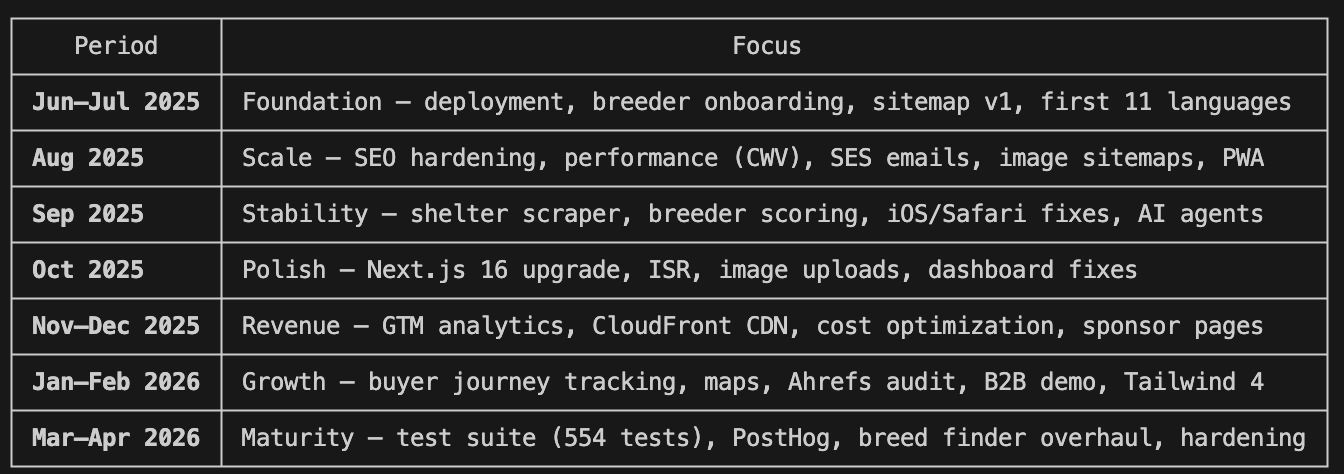
I built many more agents to do specific tasks: writing content, optimising SEO, getting backlinks, and so on. Rather than list them, I’ll let Claude Code summarise the 3k commits I shipped over the last year:
What I learned
AI coding is addictive. Not the good kind of stimulating — closer to a casino. One lever, lots of bing-bing-bong. Multiple agents, terminals, workflows, all running simultaneously, getting more done than you’d think possible. I’m used to that velocity from years of no-code building. As an AI-native developer (read: I barely coded products from scratch before AI), I’m probably desensitised at this point. I imagine an old-school developer would feel the brain rot more.
When building is this fun, push for the opposite. Less is more. Do less. Eliminate, streamline, simplify. Every idea has to fight to get into code. Every workflow gets stripped to its core. More complexity leads to more chaos, and chaos is not what any business needs — especially one with a single brain managing it all. I’ve killed more agents and more features than I can count, and it only made things better.
Free-spirited general AI doesn’t survive contact with production. This is the one I’m most bummed about. Time and time again, I wanted the most flexible, powerful systems, but they all broke down eventually. They worked great in 3–5 scenarios — until people threw everything at them.
To illustrate: imagine an AI workout builder. It generates a workout with five exercises, one of which is the Incline Dumbbell Press. Run it ten times and you’ll get at least three variants of the same exercise in the output (Incline DB Press, Incline Dumbbell Bench Press, Incline DB Bench, etc.). That alone can break downstream features — unless you bolt on another AI to harmonise everything to standardised names. So in general: build a deterministic system powered by AI, rather than a free-flowing system that accepts any AI output.
What I’d do differently
If I were starting this chapter again, I’d skip the two weeks of reflection and start the rebuild on day one. I’d kill more features, sooner. I’d assume from the beginning that any flexible, free-form AI workflow will eventually break in production, and design for determinism from the start. And I’d remind myself, every week, that the goal isn’t to build more — it’s to build less, so the business can run without me.
If you’re a solo operator going through your own version of this, I’d love to compare notes. You can reach me at sufyanosamah@gmail.com or on LinkedIn.